Tremor de terra assusta moradores de cidade do interior de SP
G1.com.br - Brazil
Um tremor de terra assustou moradores de Macedônia, a 567 km de São Paulo, na tarde de quarta-feira (21). Técnicos do Instituto de Pesquisas Tecnológicas do ...
Tremor de terra assusta moradores de Macedônia, em SP
O Globo - Rio de Janeiro,RJ,Brazil
SÃO PAULO - Pesquisadores da Universidade de São Paulo, do Instituto de Pesquisas Tecnológicas e da Unesp estudam um tremor de terra em Macedônia, ...

Esse blog foi criado em 2007 para divulgar a ciência dos Terremotos. Divulgando quando necessários os tremores no Brasil e temas importantes sobre a sismologia!
quinta-feira, 22 de outubro de 2009

Roda Viva
http://www.iptvcultura.com.br/rodaviva/19-10-2009_MADDOG/
Breve irão disponibilizar o vídeo. Muito Bom mesmo, em casa eu já não tenho mais RUINDONS.
O áudio está aberto!!!
Breve irão disponibilizar o vídeo. Muito Bom mesmo, em casa eu já não tenho mais RUINDONS.
O áudio está aberto!!!
terça-feira, 20 de outubro de 2009
Jon “Maddog” Hall - Presidente da Linux International
Hoje na Roda Viva foi um espetáculo! Depois baixem no YouTube !
--------------------
Vai ao ar hoje na TV Cultuva, o programa Roda Viva, entrevistando o grande MADDOG
Informações contidas no site: http://www2.tvcultura.com.br/rodaviva/
19/10/2009
JON “MADDOG” HALL
Presidente da Linux International
Jon “Maddog” Hall foi professor de informática e trabalhou em grandes empresas de tecnologia nos Estados Unidos. Ele é considerado o guru do software livre e passa parte do tempo viajando pelo mundo em defesa da ideia de que essa é a forma de garantir liberdade para os usuários e também mais segurança para os sistemas operacionais dos computadores.
Desde 1995, ele dirige a Linux International, uma associação sem fins lucrativos que divulga o sistema operacional Linux, um software que pode ser obtido gratuitamente e que por ter código aberto, permite alterações que outros sistemas não permitem. A experiência com esse sistema operacional deu as bases para uma crescente discussão em torno do software livre.
O Roda Viva desta segunda-feira é especial, gravado nesta sexta-feira, dia 16 de outubro, no Futurecom, evento internacional de telecomunicações e tecnologia de informação.
Entrevistadores: Wilson Moherdaui, diretor editorial do Informática Hoje; Rodolfo Lucena, editor do caderno Informática da Folha de S. Paulo e editor do blog de tecnologia Circuito Integrado da Folha Online; Sergio Amadeu, sociólogo, professor da pós-graduação em comunicação e tecnologia da Faculdade Cásper Líbero e Pedro Doria, editor-chefe do Estado de S. Paulo Digital.
Twitters no estúdio: Dalton Rocha de Oliveira, engenheiro de projetos de TI (twitter.com/daltonmaxx). Rafael de Souza Cabral, jornalista do cadenro Link, do jornalO Estado de S.Paulo (twitter.com/rafael_cabral e twitter.com/link_estadao) e Rodrigo Rodrigues da Silva, engenheiro e desenvolvedor de software livre (twitter.com/rodrigopitanga) .
Fotógrafo convidado: Priscila Alves, publicitária (www.flickr.com/photos/prialves).
Apresentação: Heródoto Barbeiro
--------------------
Vai ao ar hoje na TV Cultuva, o programa Roda Viva, entrevistando o grande MADDOG
Informações contidas no site: http://www2.tvcultura.com.br/rodaviva/
19/10/2009
JON “MADDOG” HALL
Presidente da Linux International
Jon “Maddog” Hall foi professor de informática e trabalhou em grandes empresas de tecnologia nos Estados Unidos. Ele é considerado o guru do software livre e passa parte do tempo viajando pelo mundo em defesa da ideia de que essa é a forma de garantir liberdade para os usuários e também mais segurança para os sistemas operacionais dos computadores.
Desde 1995, ele dirige a Linux International, uma associação sem fins lucrativos que divulga o sistema operacional Linux, um software que pode ser obtido gratuitamente e que por ter código aberto, permite alterações que outros sistemas não permitem. A experiência com esse sistema operacional deu as bases para uma crescente discussão em torno do software livre.
O Roda Viva desta segunda-feira é especial, gravado nesta sexta-feira, dia 16 de outubro, no Futurecom, evento internacional de telecomunicações e tecnologia de informação.
Entrevistadores: Wilson Moherdaui, diretor editorial do Informática Hoje; Rodolfo Lucena, editor do caderno Informática da Folha de S. Paulo e editor do blog de tecnologia Circuito Integrado da Folha Online; Sergio Amadeu, sociólogo, professor da pós-graduação em comunicação e tecnologia da Faculdade Cásper Líbero e Pedro Doria, editor-chefe do Estado de S. Paulo Digital.
Twitters no estúdio: Dalton Rocha de Oliveira, engenheiro de projetos de TI (twitter.com/daltonmaxx). Rafael de Souza Cabral, jornalista do cadenro Link, do jornalO Estado de S.Paulo (twitter.com/rafael_cabral e twitter.com/link_estadao) e Rodrigo Rodrigues da Silva, engenheiro e desenvolvedor de software livre (twitter.com/rodrigopitanga) .
Fotógrafo convidado: Priscila Alves, publicitária (www.flickr.com/photos/prialves).
Apresentação: Heródoto Barbeiro
quinta-feira, 15 de outubro de 2009
A FAPDF vai apoiar o Workshop de Infrasom!! VALEU FAP-DF
A FAPDF comunica que seu processo de nº 2009/00447-0 , com o título Infrasound Technology Workshop - ITW2009, foi APROVADA.
http://www.finatec.org.br/eventos/itw2009/
http://www.finatec.org.br/eventos/itw2009/
MEC esclarece: Não há risco de extinção de cursos
TEXTO: Geofísica Brasil
Leia mais (Geofísica Brasil)
O professor Paulo Roberto Wollinger, diretor de Regulação e Supervisão da Educação Superior (SESu) do MEC receberá na próxima semana no Ministério da Educação, em Brasília , um grupo de geofísicos para discutir a questão específica dos cursos de graduação. Wollinger respondeu perguntas enviadas pelo Geofísica Brasil e assegurou que não há risco de extinção dos cursos
Leia mais (Geofísica Brasil)
segunda-feira, 12 de outubro de 2009
UM ABSURDO - Ainda bem que é Sugestão!!!
DO SITE: GEOFÍSICA BRASIL
MEC quer acabar com graduação em Geofísica
Uma consulta pública realizada pela Secretaria de Ensino Superior do Ministério da Educação (MEC), que supostamente pretende contribuir para organizar a oferta de cursos superiores no país, sugere o fim da graduação em Geofísica e sua volta à grade curricular do curso de Geologia.
A consulta pública estará disponível até o dia 16 de outubro. Qualquer pessoa pode se manifestar, contra ou a favor da sugestão, desde que se identifique. Basta acessar e preencher o formulário que se encontra no Portal do MEC. Na consulta pública, a graduação em Geofísica está situada na sub-área de Geografia e dividida em três especialidades: Geofísica, Geofísica de Exploração e Geofísica Marinha e Ambiental. Se aprovada a sugestão do MEC, todas as especialidades seriam inseridas no bacharelado de Geologia.
Na área de Ciências Exatas e da Terra o projeto intitulado “Referenciais Nacionais de Cursos de Graduação” lista uma proposta de 17 cursos, excluindo a graduação em Geofísica, mas incluindo Turismo e Zootecnia.
São eles 1- Ciência da Computação - Bacharelado; 2- Ciências Naturais – Licenciatura; 3- Estatística - Bacharelado; 4- Física – Bacharelado; 5- Física - Licenciatura; 6- Geografia- Bacharelado; 7- Geografia- Licenciatura; 8- Geologia - Bacharelado; 9- Informática - Licenciatura; 10- Matemática – Bacharelado; 11- Matemática – Licenciatura; 12- Meteorologia - Bacharelado; 13- Química – Bacharelado; 14- Química – Licenciatura; 15- Sistemas da Informação - Bacharelado; 16- Turismo - Bacharelado; 17- Zootecnia - Bacharelado.
Afirma o MEC que a medida pretende “uniformizar denominações para conteúdos e perfis similares, de modo a produzir convergências que facilitem a compreensão por todos os segmentos interessados na formação superior, sem inibir possibilidades de contemplar especificidades demandadas por regiões ou setores laborais do País”.
“A convergência foi realizada por especialistas nas áreas e deve ser entendida como uma sugestão de nova denominação. Cabe às Instituições de Ensino Superior (IES), com base nas características de cada curso, adotar a denominação que julgar mais pertinente, dentre as opções disponíveis e, de acordo com a nova denominação adotada, se necessário, adaptar a matriz curricular."
domingo, 11 de outubro de 2009
prêmio News Picture Award 2008

A vencedora do prêmio News Picture Award 2008, inserida na categoria de War &Disaster News Singles.
Fotografia tirada no terramoto do dia 12 maio de 2008 na regiao de Sichuan.
fonte:butterfly
quarta-feira, 7 de outubro de 2009
A terra está tremendo muito desde o tremor de SAMOA! Será coincidência?

Magnitude 7.8 - VANUATU
| Magnitude | 7.8 |
|---|---|
| Dia-horário |
|
| Localização | 13.052°S, 166.187°E |
| Profundidade | 35 km (automático) |
| Distancias | 260 km S de Lata, Santa Cruz Islands, Solomon Isl. 295 km NNW de Luganville, Espiritu Santo, Vanuatu |
Alerta Regional! (http://www.prh.noaa.gov/ptwc/)

Simulação do Terremoto de Samoa
Animation of Tsunami Propagation
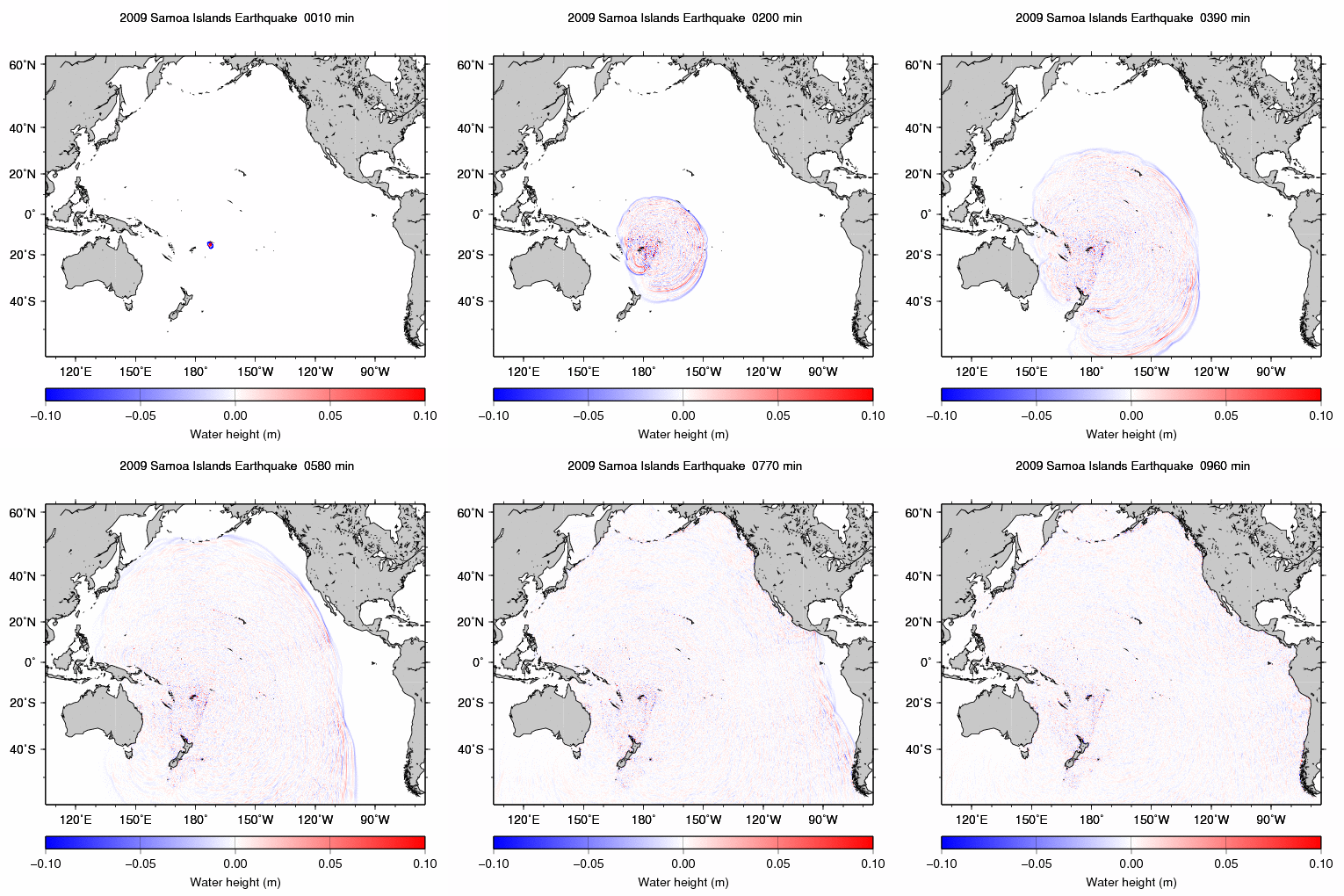
fonte:iisee
Mais informações: http://iisee.kenken.go.jp/special/20090929samoa.htm
O terremoto de Sumatra: http://iisee.kenken.go.jp/special/20090930sumatra.htm
terça-feira, 6 de outubro de 2009


sábado, 3 de outubro de 2009
Earthquakes weaken distant faults
fonte: BBC news
The major 2004 earthquake in Sumatra may have weakened the San Andreas fault, 8,000km away in California.
This is according to scientists who took measurements from the fault over two decades.
Reporting in the journal Nature, the team found that small "repeating earthquakes" became more frequent as the San Andreas Fault weakened.
This pattern, they say, could help to forecast earthquakes in the future, something that is currently impossible.
The team, led by Taka'aki Taira, of the University of California at Berkeley, studied a section of the San Andreas Fault near Parkfield, which is sometimes called the "earthquake capital of the world".
The area has long been studied by earthquake researchers and it contains a fixed array of seismometers called the high resolution seismic network.
Dr Taira, who was based at Washington DC's Carnegie Institution when he carried out the work, used measurements from these highly sensitive seismometers, some of which are several kilometres below the Earth's surface.
"The equipment is at depths where the noise level is very low, so it collects very good data," explained Dr Taira.
He and his team studied repeating earthquakes because they provided a "background frequency" against which changes in the fault could be compared.
"These events happen regularly and the size of the event is about the same," he told BBC News.
"But after Sumatra, the frequency changed - it increased - but the magnitude decreased.
"That is a signal of the fault weakening; you only have to push a little bit and the fault fails."
Fenglin Niu from Carnegie, who also took part in the research, said: "So it is possible that the strength of faults and earthquake risk is affected by seismic events on the other side of the world."
The 2004 Sumatran earthquake was magnitude 9.3 - one of the strongest on record - and triggered the tsunami that killed more than 220,000 people.
The 30 September 2009 earthquake along the same fault line was measured at magnitude 7.6.
quarta-feira, 30 de setembro de 2009
Magnitude 8.0 - Ilhas Samoa


29 de setembro de 2009 às 17:48:11 UTC
| Localização | 15.558°S, 172.073°W |
|---|---|
| Profundidade | 18 km (Valor Fixo pelo programa) |
| Distancia | 185 km ENE de Hihifo, Tonga |
fonte:youtube
segunda-feira, 28 de setembro de 2009
A terra volta tremer em Caraíbas.
Embora a magnitude 2.8, sempre é bom alertar a população que esta de volta a região. O nosso pesquisador Cristiano Chimpliganond e analista señior Daniel Caixeta estão fechando um breve relatório.
veja mais www.obsis.unb.br
veja mais www.obsis.unb.br
Estou no Campo
Estou na UHE Batalha - Instalando mais uma estação de caráter temporário. Breve colocarei fotos.
quarta-feira, 23 de setembro de 2009

Sismologia Estelar
 http://gong.nso.edu/gallery/images/harmonics/cut-away.jpg
Helioseismology and Asteroseismology are the terms for investigating our sun and other stars using seismology.
MAIS
 Fonte: http://www.uni-muenster.de/Physik.GP/en/Seismologie/index.html
Essa imagem reflete bem a sismologia
Segunda Etapa de Irapé
Hoje, a equipe de 10 pessoas sob a coordenação do Prof. Oswaldo.
Espero que tudo corra bem!! AGORA VAI!!!
Espero que tudo corra bem!! AGORA VAI!!!
quinta-feira, 17 de setembro de 2009
Global warming may bring tsunami and quakes-scientists
fonte:reuters
By Richard Meares
LONDON, Sept 16 (Reuters) - Quakes, volcanic eruptions, giant landslides and tsunamis may become more frequent as global warming changes the earth's crust, scientists said on Wednesday.
Climate-linked geological changes may also trigger "methane burps", the release of a potent greenhouse gas, currently stored in solid form under melting permafrost and the seabed, in quantities greater than all the carbon dioxide (CO2) in our air today.
"Climate change doesn't just affect the atmosphere and the oceans but the earth's crust as well. The whole earth is an interactive system," Professor Bill McGuire of University College London told Reuters, at the first major conference of scientists researching the changing climate's effects on geological hazards.
"In the political community people are almost completely unaware of any geological aspects to climate change."
The vulcanologists, seismologists, glaciologists, climatologists and landslide experts at the meeting have looked to the past to try to predict future changes, particularly to climate upheaval at the end of the last ice age, some 12,000 years ago.
"When the ice is lost, the earth's crust bounces back up again and that triggers earthquakes, which trigger submarine landslides, which cause tsunamis," said McGuire, who organized the three-day conference.
David Pyle of Oxford University said small changes in the mass of the earth's surface seems to affect volcanic activity in general, not just in places where ice receded after a cold spell. Weather patterns also seem to affect volcanic activity - not just the other way round, he told the conference.
LONDON'S ASIAN SUNSET
Behind him was a slide of a dazzlingly bright orange painting, "London sunset after Krakatau, 1883" - referring to a huge Asian volcanic eruption whose effects were seen and felt around the world.
Volcanoes can spew vast amounts of ash, sulphur, carbon dioxide and water into the upper atmosphere, reflecting sunlight and sometimes cooling the earth for a couple of years. But too many eruptions, too close together, may have the opposite effect and quicken global warming, said U.S. vulcanologist Peter Ward.
"Prior to man, the most abrupt climate change was initiated by volcanoes, but now man has taken over. Understanding why and how volcanoes did it will help man figure out what to do," he said.
Speakers were careful to point out that many findings still amounted only to hypotheses, but said evidence appeared to be mounting that the world could be in for shocks on a vast scale.
Tony Song of NASA's Jet Propulsion Laboratory in California warned of the vast power of recently discovered "glacial earthquakes" -- in which glacial ice mass crashes downwards like an enormous landslide.
In the West Antarctic, ice piled more than one mile (1.5 km) above sea level is being undermined in places by water seeping in underneath.
"Our experiments show that glacial earthquakes can generate far more powerful tsunamis than undersea earthquakes with similar magnitude," said Song.
"Several high-latitude regions, such as Chile, New Zealand and Canadian Newfoundland are particularly at risk."
He said ice sheets appeared to be disintegrating much more rapidly than thought and said glacial earthquake tsunamis were "low-probability but high-risk".
McGuire said the possible geological hazards were alarming enough, but just one small part of a scary picture if man-made CO2 emissions were not stabilized within around the next five years.
"Added to all the rest of the mayhem and chaos, these things would just be the icing on the cake," he said. "Things would be so bad that the odd tsunami or eruption won't make much difference."
(Editing by Robin Pomeroy)
By Richard Meares
LONDON, Sept 16 (Reuters) - Quakes, volcanic eruptions, giant landslides and tsunamis may become more frequent as global warming changes the earth's crust, scientists said on Wednesday.
Climate-linked geological changes may also trigger "methane burps", the release of a potent greenhouse gas, currently stored in solid form under melting permafrost and the seabed, in quantities greater than all the carbon dioxide (CO2) in our air today.
"Climate change doesn't just affect the atmosphere and the oceans but the earth's crust as well. The whole earth is an interactive system," Professor Bill McGuire of University College London told Reuters, at the first major conference of scientists researching the changing climate's effects on geological hazards.
"In the political community people are almost completely unaware of any geological aspects to climate change."
The vulcanologists, seismologists, glaciologists, climatologists and landslide experts at the meeting have looked to the past to try to predict future changes, particularly to climate upheaval at the end of the last ice age, some 12,000 years ago.
"When the ice is lost, the earth's crust bounces back up again and that triggers earthquakes, which trigger submarine landslides, which cause tsunamis," said McGuire, who organized the three-day conference.
David Pyle of Oxford University said small changes in the mass of the earth's surface seems to affect volcanic activity in general, not just in places where ice receded after a cold spell. Weather patterns also seem to affect volcanic activity - not just the other way round, he told the conference.
LONDON'S ASIAN SUNSET
Behind him was a slide of a dazzlingly bright orange painting, "London sunset after Krakatau, 1883" - referring to a huge Asian volcanic eruption whose effects were seen and felt around the world.
Volcanoes can spew vast amounts of ash, sulphur, carbon dioxide and water into the upper atmosphere, reflecting sunlight and sometimes cooling the earth for a couple of years. But too many eruptions, too close together, may have the opposite effect and quicken global warming, said U.S. vulcanologist Peter Ward.
"Prior to man, the most abrupt climate change was initiated by volcanoes, but now man has taken over. Understanding why and how volcanoes did it will help man figure out what to do," he said.
Speakers were careful to point out that many findings still amounted only to hypotheses, but said evidence appeared to be mounting that the world could be in for shocks on a vast scale.
Tony Song of NASA's Jet Propulsion Laboratory in California warned of the vast power of recently discovered "glacial earthquakes" -- in which glacial ice mass crashes downwards like an enormous landslide.
In the West Antarctic, ice piled more than one mile (1.5 km) above sea level is being undermined in places by water seeping in underneath.
"Our experiments show that glacial earthquakes can generate far more powerful tsunamis than undersea earthquakes with similar magnitude," said Song.
"Several high-latitude regions, such as Chile, New Zealand and Canadian Newfoundland are particularly at risk."
He said ice sheets appeared to be disintegrating much more rapidly than thought and said glacial earthquake tsunamis were "low-probability but high-risk".
McGuire said the possible geological hazards were alarming enough, but just one small part of a scary picture if man-made CO2 emissions were not stabilized within around the next five years.
"Added to all the rest of the mayhem and chaos, these things would just be the icing on the cake," he said. "Things would be so bad that the odd tsunami or eruption won't make much difference."
(Editing by Robin Pomeroy)
terça-feira, 15 de setembro de 2009
Earthquake D download
Earthquake 3D 2.44 download.
Observe os terremotos que estão acontecendo na Terra em 3 dimensões quase em tempo real.
Wgets Download - Feed RSS - http://www.wgets.com.br/
Observe os terremotos que estão acontecendo na Terra em 3 dimensões quase em tempo real.
Wgets Download - Feed RSS - http://www.wgets.com.br/
Assinar:
Postagens (Atom)
